
VelombeAI Systems Engineer

I design SaaS products end to end, build real-time AI systems, take products from idea to production, and use AI to ship software faster.

I'm a full-stack software engineer and product designer specializing in SaaS and AI systems. From LLMs to real-time voice, I build and ship products end-to-end , driven by a passion for understanding the big picture and making complex pieces work together.

Istanbul · Remote worldwide · Available for roles & contracts

  • Next.js
  • React
  • TypeScript
  • Python
  • OpenAI
  • LangChain
  • PostgreSQL
  • Node.js
  • Tailwind
  • FastAPI
  • Django
  • Drizzle
  • Stripe
Selected work

The work, and the decisions behind it.

These are the products and systems I've spent the most time building. From SaaS applications to AI infrastructure, each one reflects a different part of how I approach software.

01 call.velombe.com2026
  1. Tenant Appapi key → /token
  2. MCP Discoverytools/list
  3. Agent Workerlivekit-agents
  4. LiveKit RoomWebRTC · SFU
  5. Voice ClientWeb Audio API

Tools resolved per connection, never compiled in.

Voice AI Platform

Speech-to-speech agents that any SaaS product can rent, without giving up its own interface or its own data.

Problem
Adding a voice assistant normally means rebuilding the audio pipeline, the agent loop and the tool layer inside your own product. Every app pays that cost again, and every app's tools get hard-coded into whichever agent framework it picked.
What I built
A decoupled, multi-tenant voice backend. A tenant app authenticates with an API key, receives a short-lived audience-scoped JWT, and publishes its own backend tools over MCP. A shared LiveKit agent worker discovers those tools at connect time and calls them bound to the end user's scope. The client is custom Web Audio API — synthesised ringtones, waveform visualisers, and a voice-cloning enrolment flow.
Key decision
Tools are resolved per connection, never compiled in. That is the whole design: onboarding a tenant takes zero platform deploys, and a tenant can add a tool without me ever seeing it.
  • Python
  • FastAPI
  • LiveKit
  • WebRTC
  • OpenAI Realtime
  • xAI Grok Voice
  • MCP
  • Next.js
Case studyArchitect & Sole Developer
02 vibescore.dev2026
vibescore-cli
cd your-project
# macOS
npx --yes vibescore-cli | pbcopy
# Windows PowerShell
npx --yes vibescore-cli | Set-Clipboard
# Linux
npx --yes vibescore-cli | xclip -selection clipboard
✓ score copied — paste it to submit

VibeScore

Turns “built with AI” into a number you can compare.

A directory and leaderboard ranking AI-built apps on build data parsed straight from CLI transcripts — not self-reported. A 1–100 composite weighs time-to-ship, token usage and API-equivalent cost against calibrated thresholds.

Key decision

Scoring lives in the query, not the app. Window functions and CTEs through Drizzle mean rankings recompute on read, so a new submission reorders the board without a batch job.

  • Next.js 16
  • Drizzle ORM
  • PostgreSQL
  • Stripe
  • Better-Auth
Case studySole Developer & Designer
03 heytwy.com2026
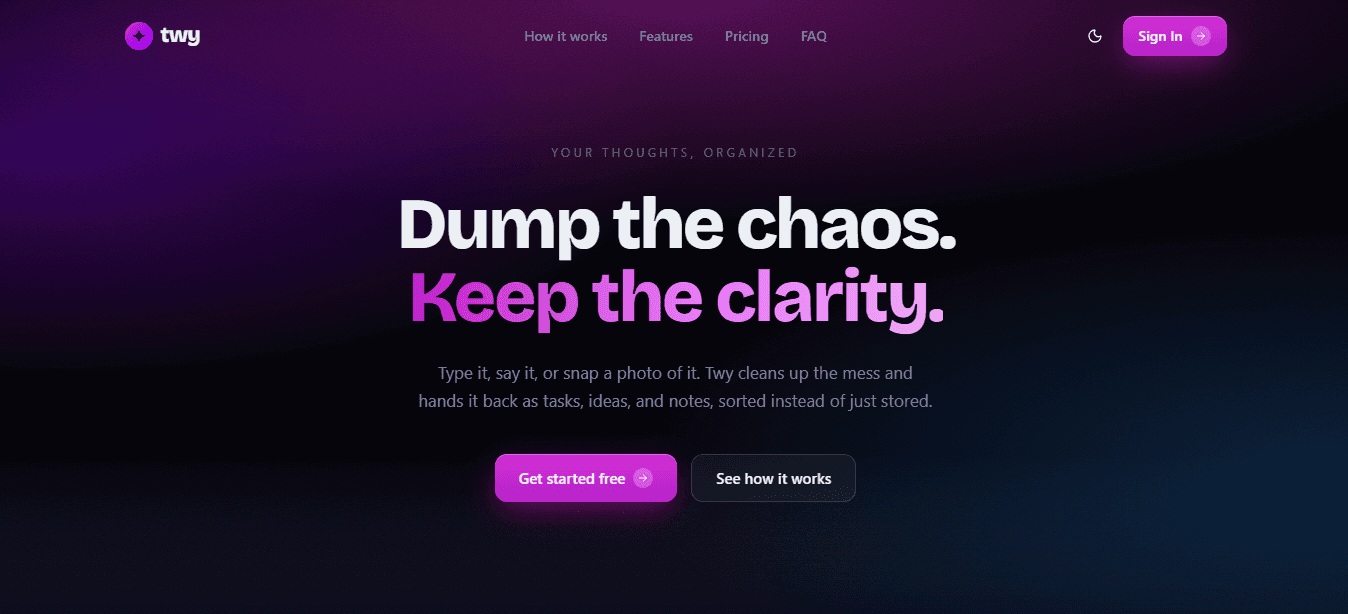
Twy — AI capture interface with auto-clustered notes and tasks

Twy

A second brain you can talk to.

Typed, spoken, or photographed input goes in unstructured and comes back organized into related tasks, ideas, and notes. Hybrid semantic retrieval runs on pgvector with OpenAI's text-embedding-3-small model.

Key decision

Twy ships no speech code. It publishes tools and lets the Voice AI Platform call them over MCP — the payoff for building that platform as infrastructure rather than a feature.

  • Next.js
  • pgvector
  • OpenAI
  • MCP
Case studySole Developer & Designer

Also shipped

  • Describe an invoice in plain language and it generates the document. Automated reminders, payment links, multi-currency, and tax handling. Re-architected front to back in one week using my own boilerplate.

    • Next.js
    • Vercel AI SDK
    • PostgreSQL
    • Stripe
  • The boilerplate under the rest. Agentic chat with streaming, Better-Auth with team workspaces, Stripe billing, QStash background queues, human-in-the-loop approval — and a CLAUDE.md written so coding agents can navigate the codebase without being re-briefed every session.

    • Next.js
    • Better-Auth
    • Stripe
    • Drizzle
    • Upstash
    • Resend
How I build

Start with the problem, not the spec.

Bring me the problem and the constraints. I dive straight into the domain, isolate the core workflow, and build toward tangible value before over-engineering the rest.

  1. 01

    Understand the domain

    Before writing a line of code, I map out the users, the constraints, and the end goal. I want to understand the actual workflow, not just the feature request.

  2. 02

    Isolate the core

    I identify the workflows that matter most and build around them first. A small, well-architected core gives the rest of the product a solid foundation to grow from.

  3. 03

    Build with leverage

    I use AI tooling to accelerate implementation, exploration, and refactoring. But I drive the architecture, review the output, and stay strictly accountable for the code.

  4. 04

    Keep the system coherent

    As the product scales, I obsess over the boundaries: architecture, data, APIs, and UI. Every new feature should make the system better, not just bigger.

  5. 05

    Ship, learn, iterate

    Software only improves when it meets reality. I prioritize getting a working version into users' hands to learn and adapt, rather than trying to predict everything upfront.

Jean Chrinot, AI systems engineer, IstanbulIstanbul, Türkiye

EDUCATION & LANGUAGES

M.Sc. Computer Engineering
Kocaeli University · 2023–2026
B.Sc. Electronics & Communication Eng.
Kocaeli University · 2016–2020
Languages
Malagasy (native) · English · French · Turkish
About

I'd rather own the whole problem.

I'm a software engineer working across full-stack development, SaaS, and AI systems. I tend to gravitate toward focused, domain-specific products where understanding the problem matters as much as the technology behind it.

I like being involved from the first idea through architecture, interface, implementation, and deployment. I've also led engineering work within a team, so I’m comfortable collaborating and handing off when that makes sense. What I enjoy most is staying close enough to the product that the technical decisions and the end result remain connected.

For the past two years, I've also been working in clinical AI research alongside my M.Sc. at Kocaeli University. It's given me a useful perspective on the gap between building a capable model and building something that is actually useful.

Where the hours went.

  1. AI Researcher & Frontend Designer

    2025 — Present

    WINS Research Center · Kocaeli, Türkiye

    Co-developing an AI clinical decision support system for diabetes self-management under a TÜSEB-funded initiative, coordinating between medical stakeholders and infrastructure teams. Trained a CNN food-classification model and calibrated its error rates for dietary volume estimation; wired in multimodal LLMs for spatial reasoning and portion analysis.

  2. Lead AI Engineer

    Jun 2022 — Jul 2025

    SayHey Inc. · Remote — Romania

    Developed and shipped a SaaS chatbot-builder platform, integrating LLM capabilities via LangChain so customers could compose their own agents. Built the React Flow visual editor that cut configuration time. Owned sprint planning, architecture review and the technical roadmap for the team.

  3. Full-Stack Web Developer

    Dec 2020 — Jun 2022

    MindView Platform · Remote — Romania

    Designed and deployed highly available applications on Laravel, React and Django REST. Designed relational and non-relational schemas across PostgreSQL, MySQL and MongoDB.

Technical depth

What I reach for, and why.

Not a proficiency chart. Four areas, each with the principles that shape how I use the tools.

AI & agentic

The model is one part of the system. I care just as much about context, tool boundaries, latency, failure handling, and what the application does when the model gets it wrong.

  • OpenAI Realtime
  • xAI Grok Voice
  • Vercel AI SDK
  • LangChain
  • LangGraph
  • Model Context Protocol
  • Tool calling
  • Multi-agent workflows
  • RAG
  • pgvector
  • Multimodal vision
  • CNNs

Product & frontend

The interface is part of the product, not a layer added at the end. I care about clear flows, useful feedback, and interfaces that make complex systems feel straightforward.

  • TypeScript
  • Next.js
  • React
  • Tailwind CSS
  • Web Audio API
  • React Flow

Backend & data

I prefer simple systems that keep important logic close to the data. Good schemas, well-designed queries, and clear boundaries usually remove more complexity than another layer of abstraction.

  • Node.js
  • Python
  • FastAPI
  • Django
  • Laravel
  • PostgreSQL
  • Neon
  • Supabase
  • MySQL
  • MongoDB
  • Drizzle ORM
  • Prisma
  • Better-Auth
  • Stripe

Real-time & infrastructure

I like understanding what happens below the application layer. Whether the system runs on managed infrastructure or a machine I manage myself, I want to understand how it is deployed, observed, and kept reliable.

  • LiveKit
  • WebRTC
  • WebSockets
  • Asyncio
  • AWS
  • DigitalOcean
  • Ubuntu
  • Vercel
  • systemd
  • Nginx
  • Let's Encrypt
Next

Bring me the whole problem.

Tell me what you're trying to build, what is getting in the way, and what constraints you're working with. A paragraph is enough to start. I'll take a look and let you know how I can help.

Open to remote roles & contractsReplies within one business day · Istanbul · Remote worldwide